Pilates Blog | Latte Pilates & Coffee Brussels
Pilates

Pilates for Lower Back Pain: Your Complete Guide to Relief and Prevention

Pilates for Lower Back Pain: Your Complete Guide to Relief and Prevention

June 17, 2025
June 17, 2025
Stretching
Stretching
Stretching

Pilates for Lower Back Pain: Your Complete Guide to Relief and Prevention

Lower back pain is one of the most common health complaints affecting modern adults, impacting nearly 80% of people at some point in their lives. Whether it's a dull ache from hours at a desk, sharp pain from lifting something incorrectly, or chronic discomfort that seems to have no clear cause, back pain can dramatically affect your quality of life, limiting everything from your ability to exercise to simple daily tasks like tying your shoes.

For many people, the journey to finding relief feels frustrating and endless. Traditional treatments often focus on temporary solutions – pain medication that masks symptoms, passive therapies that provide short-term relief, or aggressive interventions that come with risks and lengthy recovery times. What if there was a different approach? One that addresses the root causes of back pain rather than just treating symptoms?

Enter Pilates – a movement method that has been helping people overcome back pain for nearly a century. Unlike approaches that simply rest or stretch painful areas, Pilates strengthens the deep stabilizing muscles that support your spine, improves your posture and movement patterns, and gives you tools to prevent pain from returning. Originally developed by Joseph Pilates while working with injured soldiers during World War I, this method has proven remarkably effective at addressing the biomechanical imbalances and weaknesses that lead to chronic back pain.

In this comprehensive guide, we'll explore how Pilates specifically addresses lower back pain, which exercises are most beneficial, and how you can build a practice that not only relieves your current discomfort but prevents future episodes. Whether you're dealing with acute pain, chronic discomfort, or simply want to protect your back as you age, understanding how to use Pilates therapeutically can transform your relationship with your spine.

Understanding lower back pain: Why it happens

The modern back pain epidemic: To address back pain effectively, we first need to understand why it occurs so frequently in our modern world. Your lower back wasn't designed for the way we live today.

  • Prolonged sitting: The average person now sits 9-13 hours per day between commuting, desk work, and leisure time. This prolonged sitting weakens your core muscles, tightens your hip flexors, and places sustained pressure on your lumbar spine. Your body interprets this static position as the "new normal" and adapts accordingly – unfortunately, in ways that make you vulnerable to pain.

  • Poor posture patterns: Hunching over phones and computers creates a forward head position that shifts your center of gravity. This forces your lower back to compensate, creating excessive curvature in your lumbar spine and chronic muscle tension. Over time, these postural deviations become your default position, setting you up for injury and pain.

  • Weak core muscles: Your core acts like a natural back brace, supporting your spine from all angles. When these muscles are weak – particularly the deep stabilizers like your transverse abdominis and multifidus – your spine lacks proper support. Other muscles then overwork to compensate, leading to tension, fatigue, and eventually pain.

  • Muscular imbalances: Modern life creates predictable patterns of tight and weak muscles. Typically, hip flexors and lower back muscles become tight and overactive, while abdominals and glutes become weak and underactive. These imbalances pull your pelvis out of optimal alignment, creating stress on your lumbar spine.

  • Lack of movement variety: Our bodies crave varied movement, but modern life is repetitive. We perform the same motions day after day, creating overuse in some areas and underuse in others. This lack of movement diversity prevents muscles from functioning optimally and reduces the resilience of your spine.

How Pilates addresses the root causes

A targeted approach to back pain relief: Pilates doesn't just treat symptoms – it systematically addresses every factor that contributes to lower back pain. This is why research consistently shows Pilates to be effective for both acute and chronic back pain relief.

  • Core stabilization: Pilates specifically targets the deep core muscles that stabilize your spine – the transverse abdominis, multifidus, pelvic floor, and diaphragm. These muscles work together like an internal corset, supporting your spine during movement and reducing stress on spinal structures. Strengthening these stabilizers is arguably the most important factor in preventing and relieving back pain.

  • Spinal articulation: Many Pilates exercises involve moving through your spine one vertebra at a time. This articulation improves the mobility of spinal segments that have become stiff, distributes movement more evenly across your entire spine, and helps identify areas of restriction that may be contributing to pain.

  • Postural correction: Pilates systematically addresses the muscle imbalances that create poor posture. By strengthening weak postural muscles and stretching tight ones, Pilates helps restore your spine to its optimal neutral alignment. This reduces chronic strain on back muscles and joints.

  • Body awareness: Perhaps one of Pilates' most valuable contributions is the heightened body awareness it develops. You learn to recognize poor postural habits as they happen and correct them in real-time. This awareness extends beyond your Pilates practice into daily activities, helping you move in ways that protect rather than harm your back.

  • Functional strength: Unlike isolated exercises that work muscles in unnatural ways, Pilates builds functional strength through movement patterns that mirror real life. This means the strength you build directly translates to activities like lifting, bending, reaching, and carrying – making you more resilient against injury.

  • Flexibility with stability: Pilates uniquely combines flexibility work with strength training. You don't just stretch tight muscles – you build strength through your full range of motion. This creates balanced, functional flexibility that supports pain-free movement rather than creating instability.

Essential Pilates exercises for back pain relief

Your therapeutic toolkit: These mat Pilates exercises specifically target the mechanisms behind lower back pain. Start gently, focus on proper form, and progress gradually as your strength and confidence build.

Pelvic tilts – Your foundation exercise:

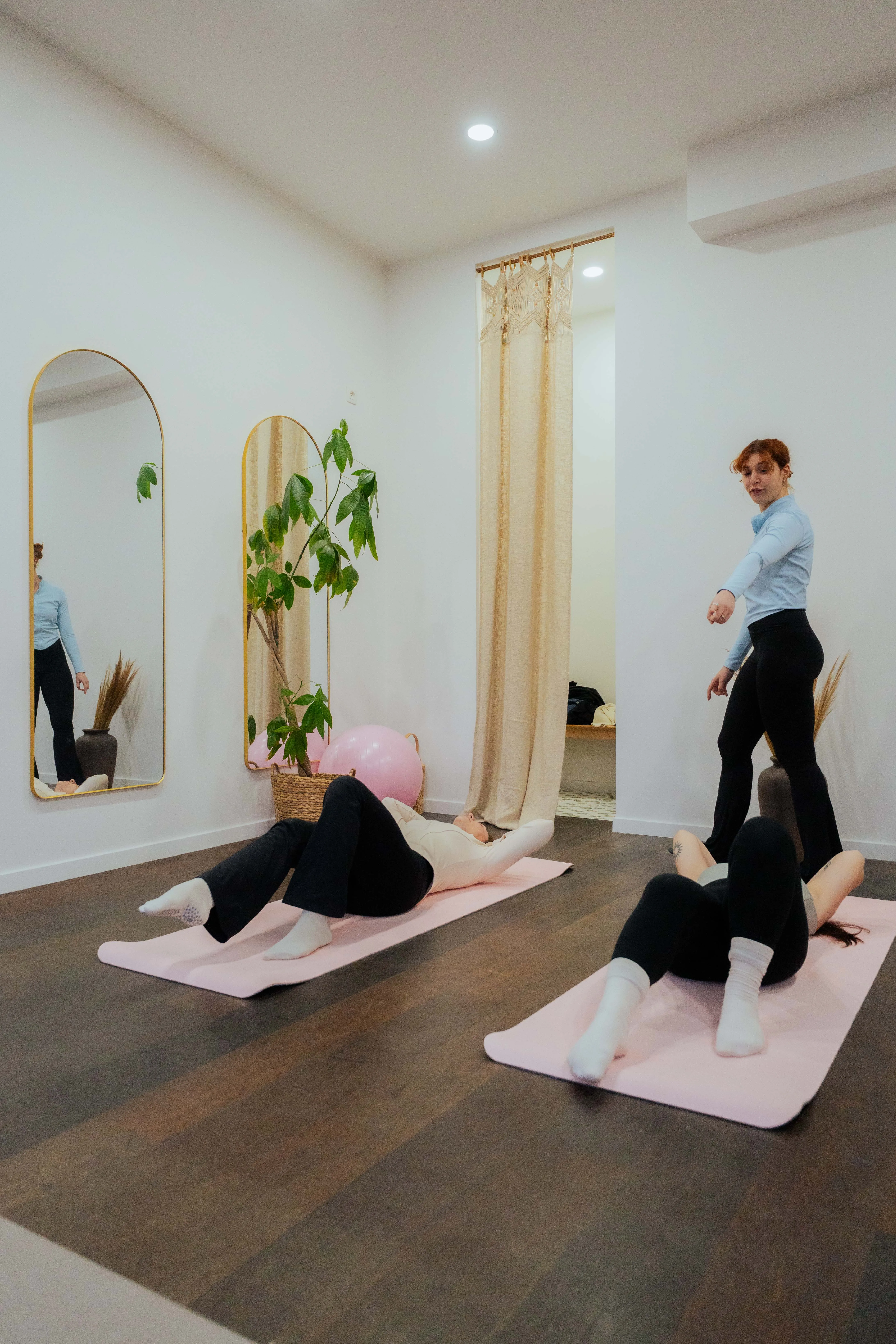
This simple but powerful exercise teaches you to control your pelvis and engage your deep core muscles. Lie on your back with knees bent and feet flat on the floor. Slowly tilt your pelvis to press your lower back into the mat, then release to neutral. This subtle movement activates your transverse abdominis without straining your back.

  • Why it helps: Pelvic tilts teach the fundamental skill of core engagement while moving your spine safely. This movement pattern forms the foundation for nearly every other Pilates exercise and helps you learn to stabilize your spine during daily activities.

  • Progression: Once you master the basic tilt, try holding the engagement for 5-10 seconds, or coordinate the movement with your breath – inhaling in neutral, exhaling as you tilt.

Knee folds – Building core control:

From the same position as pelvic tilts, maintain a stable pelvis while slowly lifting one knee toward your chest, then lowering it back down. Alternate legs, focusing on keeping your lower back still and your pelvis stable throughout the movement.

  • Why it helps: This exercise challenges your core to maintain stability while your legs move independently – exactly what your body needs to do during walking and other daily activities. It builds the strength and control to keep your back safe during movement.

  • Key points: Move slowly and deliberately. If your back arches or your pelvis rocks when lifting your leg, you've gone beyond your current control capacity. Work within a smaller range of motion until you build more strength.

Bridge – Strengthening the posterior chain:

Lie on your back with knees bent and feet hip-width apart. Slowly peel your spine off the mat, one vertebra at a time, until your body forms a straight line from shoulders to knees. Hold briefly, then articulate back down with control.

  • Why it helps: Bridge strengthens your glutes, hamstrings, and lower back muscles while teaching spinal articulation. Strong glutes are essential for back health, as they take pressure off your lower back during activities like walking, climbing stairs, and lifting.

  • Variations: For less intensity, lift only halfway. For more challenge, try single-leg bridges (keeping one foot lifted while lifting and lowering your hips) once you've mastered the basic version.

Cat-cow stretch – Spinal mobility:

Start on hands and knees with a neutral spine. Slowly round your spine toward the ceiling (cat), then reverse the movement by arching your back and lifting your head and tailbone (cow). Move smoothly between these positions, coordinating movement with your breath.

  • Why it helps: This exercise gently mobilizes every segment of your spine, promoting flexibility and reducing stiffness. The rhythmic movement also helps reduce muscle tension and improves circulation to spinal tissues.

  • Modifications: If kneeling bothers your knees, place a folded towel underneath them. Move within a comfortable range – never force the movement into pain.

Bird dog – Core stability and coordination:

From hands and knees, extend one arm forward and the opposite leg back, keeping your torso stable. Hold for a few seconds, then return to start and switch sides. Focus on keeping your hips level and your spine neutral throughout.

  • Why it helps: Bird dog is one of the most effective exercises for training core stability during asymmetrical movements. It strengthens the muscles that prevent rotation and side-bending of your spine – crucial for activities like reaching, carrying groceries on one side, or picking things up.

  • Common mistakes: Avoid letting your hips rotate or your lower back sag. Start with just lifting your arm or just lifting your leg if the full exercise is too challenging initially.

Spine stretch forward – Lengthening and releasing:

Sit tall with legs extended in front of you (knees can be slightly bent if hamstrings are tight). Reach your arms forward at shoulder height, then slowly round your spine forward, reaching toward your toes while maintaining length through your spine. Roll back up to sitting tall.

  • Why it helps: This exercise gently stretches your back muscles while teaching you to articulate your spine with control. It also stretches tight hamstrings, which often contribute to lower back pain by pulling your pelvis into a posterior tilt.

  • Focus points: Think about creating space between each vertebra as you round forward rather than collapsing. Keep your abdominals engaged to support your lower back throughout the movement.

Building a therapeutic Pilates practice

Creating your personal back pain relief routine: Having exercises is one thing – knowing how to put them together into an effective practice is another. Here's how to structure your Pilates practice for maximum back pain relief.

  • Frequency and duration: For active back pain, aim for 15-20 minutes of gentle Pilates exercises daily. This frequency helps retrain your movement patterns and build strength consistently. As pain improves, you can shift to 3-4 longer sessions per week to maintain your progress and continue building strength.

  • Warm-up is essential: Never skip your warm-up, especially when dealing with back pain. Start with 5 minutes of gentle movements like pelvic tilts, cat-cow, and breathing exercises to prepare your body and mind for more challenging work.

  • Progressive approach: Begin with the gentlest versions of exercises and progress only when you can maintain perfect form. It's better to do simple exercises perfectly than complex exercises poorly. Pain or form breakdown are signals to regress to an easier variation.

  • Consistency over intensity: A short daily practice delivers better results than occasional intense sessions. Your body adapts through consistent stimulus over time. Even 10 minutes of mindful Pilates each day creates meaningful change.

  • Listen to your body: Pilates should never cause sharp pain. You might feel muscular work and stretching sensations, but these should feel productive, not harmful. If an exercise increases your back pain, skip it or modify it further until you build more strength and control.

Lifestyle integration: Beyond the mat

Making Pilates principles work for you 24/7: The real magic of Pilates for back pain happens when you apply what you learn on the mat to your daily life. Here's how to carry Pilates principles into everything you do.

  • Sitting posture: Apply your Pilates awareness to how you sit. Imagine your pelvis as a bowl – you want it level, not spilled forward or back. Maintain a gentle engagement of your core without holding your breath. Stand up and move every 30-45 minutes to prevent stiffness.

  • Lifting technique: Use your Pilates training when lifting anything. Engage your core first, hinge from your hips (not your waist), and keep the object close to your body. Your legs should do the work, not your back.

  • Walking alignment: Apply your improved posture to walking. Lead from your center, maintain length through your spine, and let your arms swing naturally. Notice how your Pilates practice makes walking feel smoother and more efficient.

  • Sleep position: Your sleeping position affects your back health. If you sleep on your side, place a pillow between your knees to maintain pelvic alignment. Back sleepers can place a pillow under their knees to reduce lumbar strain.

  • Breathing patterns: Many people with chronic pain develop shallow breathing patterns that increase muscle tension. Practice the deep, lateral breathing you learn in Pilates throughout your day to reduce stress and tension.

When to seek professional guidance

Working with qualified instructors: While Pilates is generally safe for back pain, working with a qualified instructor accelerates your progress and ensures you're practicing safely.

  • Initial assessment: A good Pilates instructor will assess your posture, movement patterns, and specific pain triggers before recommending exercises. This personalized approach ensures you're working on what your body actually needs.

  • Form corrections: Proper form is crucial for both safety and effectiveness. An instructor provides real-time corrections that help you understand how exercises should feel and ensures you're targeting the right muscles.

  • Progression planning: An instructor helps you progress appropriately, knowing when to advance you to more challenging variations and when to pull back if you're not ready.

  • Red flag recognition: While Pilates helps most back pain, some conditions require medical attention. A qualified instructor knows when to refer you to a healthcare provider for evaluation before continuing with exercise.

In summary

Lower back pain doesn't have to be a life sentence. While it's one of the most common health complaints in modern society, it's also one of the most responsive to intelligent movement therapy. Pilates offers a comprehensive solution that addresses not just your symptoms but the underlying causes of your pain – weak core muscles, poor posture, muscular imbalances, and dysfunctional movement patterns.

The beauty of using Pilates for back pain relief lies in its sustainable approach. You're not just receiving passive treatment or masking pain with medication – you're actively building strength, improving your body awareness, and learning movement skills that protect your back for life. The exercises and principles you learn become tools you can use anytime, anywhere, without equipment or professional supervision.

Starting a Pilates practice for back pain requires patience and consistency. You're retraining movement patterns that have developed over years or even decades. But with regular practice, most people notice reduced pain within 2-4 weeks and significant improvement within 2-3 months. More importantly, they develop the strength, awareness, and skills to keep their backs healthy long-term.

Your back pain is your body's way of communicating that something needs to change. Pilates provides the roadmap for that change, offering a gentle, effective, and empowering path to a stronger, pain-free back. The journey begins with a single session – and every moment you invest in your practice is an investment in a more comfortable, active, and pain-free future.
Pilates for Lower Back Pain: Your Complete Guide to Relief and Prevention

Lower back pain is one of the most common health complaints affecting modern adults, impacting nearly 80% of people at some point in their lives. Whether it's a dull ache from hours at a desk, sharp pain from lifting something incorrectly, or chronic discomfort that seems to have no clear cause, back pain can dramatically affect your quality of life, limiting everything from your ability to exercise to simple daily tasks like tying your shoes.

For many people, the journey to finding relief feels frustrating and endless. Traditional treatments often focus on temporary solutions – pain medication that masks symptoms, passive therapies that provide short-term relief, or aggressive interventions that come with risks and lengthy recovery times. What if there was a different approach? One that addresses the root causes of back pain rather than just treating symptoms?

Enter Pilates – a movement method that has been helping people overcome back pain for nearly a century. Unlike approaches that simply rest or stretch painful areas, Pilates strengthens the deep stabilizing muscles that support your spine, improves your posture and movement patterns, and gives you tools to prevent pain from returning. Originally developed by Joseph Pilates while working with injured soldiers during World War I, this method has proven remarkably effective at addressing the biomechanical imbalances and weaknesses that lead to chronic back pain.

In this comprehensive guide, we'll explore how Pilates specifically addresses lower back pain, which exercises are most beneficial, and how you can build a practice that not only relieves your current discomfort but prevents future episodes. Whether you're dealing with acute pain, chronic discomfort, or simply want to protect your back as you age, understanding how to use Pilates therapeutically can transform your relationship with your spine.

Understanding lower back pain: Why it happens

The modern back pain epidemic: To address back pain effectively, we first need to understand why it occurs so frequently in our modern world. Your lower back wasn't designed for the way we live today.

  • Prolonged sitting: The average person now sits 9-13 hours per day between commuting, desk work, and leisure time. This prolonged sitting weakens your core muscles, tightens your hip flexors, and places sustained pressure on your lumbar spine. Your body interprets this static position as the "new normal" and adapts accordingly – unfortunately, in ways that make you vulnerable to pain.

  • Poor posture patterns: Hunching over phones and computers creates a forward head position that shifts your center of gravity. This forces your lower back to compensate, creating excessive curvature in your lumbar spine and chronic muscle tension. Over time, these postural deviations become your default position, setting you up for injury and pain.

  • Weak core muscles: Your core acts like a natural back brace, supporting your spine from all angles. When these muscles are weak – particularly the deep stabilizers like your transverse abdominis and multifidus – your spine lacks proper support. Other muscles then overwork to compensate, leading to tension, fatigue, and eventually pain.

  • Muscular imbalances: Modern life creates predictable patterns of tight and weak muscles. Typically, hip flexors and lower back muscles become tight and overactive, while abdominals and glutes become weak and underactive. These imbalances pull your pelvis out of optimal alignment, creating stress on your lumbar spine.

  • Lack of movement variety: Our bodies crave varied movement, but modern life is repetitive. We perform the same motions day after day, creating overuse in some areas and underuse in others. This lack of movement diversity prevents muscles from functioning optimally and reduces the resilience of your spine.

How Pilates addresses the root causes

A targeted approach to back pain relief: Pilates doesn't just treat symptoms – it systematically addresses every factor that contributes to lower back pain. This is why research consistently shows Pilates to be effective for both acute and chronic back pain relief.

  • Core stabilization: Pilates specifically targets the deep core muscles that stabilize your spine – the transverse abdominis, multifidus, pelvic floor, and diaphragm. These muscles work together like an internal corset, supporting your spine during movement and reducing stress on spinal structures. Strengthening these stabilizers is arguably the most important factor in preventing and relieving back pain.

  • Spinal articulation: Many Pilates exercises involve moving through your spine one vertebra at a time. This articulation improves the mobility of spinal segments that have become stiff, distributes movement more evenly across your entire spine, and helps identify areas of restriction that may be contributing to pain.

  • Postural correction: Pilates systematically addresses the muscle imbalances that create poor posture. By strengthening weak postural muscles and stretching tight ones, Pilates helps restore your spine to its optimal neutral alignment. This reduces chronic strain on back muscles and joints.

  • Body awareness: Perhaps one of Pilates' most valuable contributions is the heightened body awareness it develops. You learn to recognize poor postural habits as they happen and correct them in real-time. This awareness extends beyond your Pilates practice into daily activities, helping you move in ways that protect rather than harm your back.

  • Functional strength: Unlike isolated exercises that work muscles in unnatural ways, Pilates builds functional strength through movement patterns that mirror real life. This means the strength you build directly translates to activities like lifting, bending, reaching, and carrying – making you more resilient against injury.

  • Flexibility with stability: Pilates uniquely combines flexibility work with strength training. You don't just stretch tight muscles – you build strength through your full range of motion. This creates balanced, functional flexibility that supports pain-free movement rather than creating instability.

Essential Pilates exercises for back pain relief

Your therapeutic toolkit: These mat Pilates exercises specifically target the mechanisms behind lower back pain. Start gently, focus on proper form, and progress gradually as your strength and confidence build.

Pelvic tilts – Your foundation exercise:

This simple but powerful exercise teaches you to control your pelvis and engage your deep core muscles. Lie on your back with knees bent and feet flat on the floor. Slowly tilt your pelvis to press your lower back into the mat, then release to neutral. This subtle movement activates your transverse abdominis without straining your back.

  • Why it helps: Pelvic tilts teach the fundamental skill of core engagement while moving your spine safely. This movement pattern forms the foundation for nearly every other Pilates exercise and helps you learn to stabilize your spine during daily activities.

  • Progression: Once you master the basic tilt, try holding the engagement for 5-10 seconds, or coordinate the movement with your breath – inhaling in neutral, exhaling as you tilt.

Knee folds – Building core control:

From the same position as pelvic tilts, maintain a stable pelvis while slowly lifting one knee toward your chest, then lowering it back down. Alternate legs, focusing on keeping your lower back still and your pelvis stable throughout the movement.

  • Why it helps: This exercise challenges your core to maintain stability while your legs move independently – exactly what your body needs to do during walking and other daily activities. It builds the strength and control to keep your back safe during movement.

  • Key points: Move slowly and deliberately. If your back arches or your pelvis rocks when lifting your leg, you've gone beyond your current control capacity. Work within a smaller range of motion until you build more strength.

Bridge – Strengthening the posterior chain:

Lie on your back with knees bent and feet hip-width apart. Slowly peel your spine off the mat, one vertebra at a time, until your body forms a straight line from shoulders to knees. Hold briefly, then articulate back down with control.

  • Why it helps: Bridge strengthens your glutes, hamstrings, and lower back muscles while teaching spinal articulation. Strong glutes are essential for back health, as they take pressure off your lower back during activities like walking, climbing stairs, and lifting.

  • Variations: For less intensity, lift only halfway. For more challenge, try single-leg bridges (keeping one foot lifted while lifting and lowering your hips) once you've mastered the basic version.

Cat-cow stretch – Spinal mobility:

Start on hands and knees with a neutral spine. Slowly round your spine toward the ceiling (cat), then reverse the movement by arching your back and lifting your head and tailbone (cow). Move smoothly between these positions, coordinating movement with your breath.

  • Why it helps: This exercise gently mobilizes every segment of your spine, promoting flexibility and reducing stiffness. The rhythmic movement also helps reduce muscle tension and improves circulation to spinal tissues.

  • Modifications: If kneeling bothers your knees, place a folded towel underneath them. Move within a comfortable range – never force the movement into pain.

Bird dog – Core stability and coordination:

From hands and knees, extend one arm forward and the opposite leg back, keeping your torso stable. Hold for a few seconds, then return to start and switch sides. Focus on keeping your hips level and your spine neutral throughout.

  • Why it helps: Bird dog is one of the most effective exercises for training core stability during asymmetrical movements. It strengthens the muscles that prevent rotation and side-bending of your spine – crucial for activities like reaching, carrying groceries on one side, or picking things up.

  • Common mistakes: Avoid letting your hips rotate or your lower back sag. Start with just lifting your arm or just lifting your leg if the full exercise is too challenging initially.

Spine stretch forward – Lengthening and releasing:

Sit tall with legs extended in front of you (knees can be slightly bent if hamstrings are tight). Reach your arms forward at shoulder height, then slowly round your spine forward, reaching toward your toes while maintaining length through your spine. Roll back up to sitting tall.

  • Why it helps: This exercise gently stretches your back muscles while teaching you to articulate your spine with control. It also stretches tight hamstrings, which often contribute to lower back pain by pulling your pelvis into a posterior tilt.

  • Focus points: Think about creating space between each vertebra as you round forward rather than collapsing. Keep your abdominals engaged to support your lower back throughout the movement.

Building a therapeutic Pilates practice

Creating your personal back pain relief routine: Having exercises is one thing – knowing how to put them together into an effective practice is another. Here's how to structure your Pilates practice for maximum back pain relief.

  • Frequency and duration: For active back pain, aim for 15-20 minutes of gentle Pilates exercises daily. This frequency helps retrain your movement patterns and build strength consistently. As pain improves, you can shift to 3-4 longer sessions per week to maintain your progress and continue building strength.

  • Warm-up is essential: Never skip your warm-up, especially when dealing with back pain. Start with 5 minutes of gentle movements like pelvic tilts, cat-cow, and breathing exercises to prepare your body and mind for more challenging work.

  • Progressive approach: Begin with the gentlest versions of exercises and progress only when you can maintain perfect form. It's better to do simple exercises perfectly than complex exercises poorly. Pain or form breakdown are signals to regress to an easier variation.

  • Consistency over intensity: A short daily practice delivers better results than occasional intense sessions. Your body adapts through consistent stimulus over time. Even 10 minutes of mindful Pilates each day creates meaningful change.

  • Listen to your body: Pilates should never cause sharp pain. You might feel muscular work and stretching sensations, but these should feel productive, not harmful. If an exercise increases your back pain, skip it or modify it further until you build more strength and control.

Lifestyle integration: Beyond the mat

Making Pilates principles work for you 24/7: The real magic of Pilates for back pain happens when you apply what you learn on the mat to your daily life. Here's how to carry Pilates principles into everything you do.

  • Sitting posture: Apply your Pilates awareness to how you sit. Imagine your pelvis as a bowl – you want it level, not spilled forward or back. Maintain a gentle engagement of your core without holding your breath. Stand up and move every 30-45 minutes to prevent stiffness.

  • Lifting technique: Use your Pilates training when lifting anything. Engage your core first, hinge from your hips (not your waist), and keep the object close to your body. Your legs should do the work, not your back.

  • Walking alignment: Apply your improved posture to walking. Lead from your center, maintain length through your spine, and let your arms swing naturally. Notice how your Pilates practice makes walking feel smoother and more efficient.

  • Sleep position: Your sleeping position affects your back health. If you sleep on your side, place a pillow between your knees to maintain pelvic alignment. Back sleepers can place a pillow under their knees to reduce lumbar strain.

  • Breathing patterns: Many people with chronic pain develop shallow breathing patterns that increase muscle tension. Practice the deep, lateral breathing you learn in Pilates throughout your day to reduce stress and tension.

When to seek professional guidance

Working with qualified instructors: While Pilates is generally safe for back pain, working with a qualified instructor accelerates your progress and ensures you're practicing safely.

  • Initial assessment: A good Pilates instructor will assess your posture, movement patterns, and specific pain triggers before recommending exercises. This personalized approach ensures you're working on what your body actually needs.

  • Form corrections: Proper form is crucial for both safety and effectiveness. An instructor provides real-time corrections that help you understand how exercises should feel and ensures you're targeting the right muscles.

  • Progression planning: An instructor helps you progress appropriately, knowing when to advance you to more challenging variations and when to pull back if you're not ready.

  • Red flag recognition: While Pilates helps most back pain, some conditions require medical attention. A qualified instructor knows when to refer you to a healthcare provider for evaluation before continuing with exercise.

In summary

Lower back pain doesn't have to be a life sentence. While it's one of the most common health complaints in modern society, it's also one of the most responsive to intelligent movement therapy. Pilates offers a comprehensive solution that addresses not just your symptoms but the underlying causes of your pain – weak core muscles, poor posture, muscular imbalances, and dysfunctional movement patterns.

The beauty of using Pilates for back pain relief lies in its sustainable approach. You're not just receiving passive treatment or masking pain with medication – you're actively building strength, improving your body awareness, and learning movement skills that protect your back for life. The exercises and principles you learn become tools you can use anytime, anywhere, without equipment or professional supervision.

Starting a Pilates practice for back pain requires patience and consistency. You're retraining movement patterns that have developed over years or even decades. But with regular practice, most people notice reduced pain within 2-4 weeks and significant improvement within 2-3 months. More importantly, they develop the strength, awareness, and skills to keep their backs healthy long-term.

Your back pain is your body's way of communicating that something needs to change. Pilates provides the roadmap for that change, offering a gentle, effective, and empowering path to a stronger, pain-free back. The journey begins with a single session – and every moment you invest in your practice is an investment in a more comfortable, active, and pain-free future.

Lines
Yoga
Yoga
Stretching
Yoga

Join 200+ women who've discovered that the best workout ends with the perfect latte.

Lines
Yoga
Yoga
Stretching
Yoga

Join 200+ women who've discovered that the best workout ends with the perfect latte.