Pilates Blog | Latte Pilates & Coffee Brussels
Pilates

Mat Pilates: Why This Simple Practice Delivers Extraordinary Results

Mat Pilates: Why This Simple Practice Delivers Extraordinary Results

June 17, 2025
June 17, 2025
Yoga
Yoga
Yoga

Mat Pilates: Why This Simple Practice Delivers Extraordinary Results

In a fitness world obsessed with high-tech equipment, complicated machines, and the latest workout gadgets, there's something refreshingly pure about mat Pilates. Armed with nothing more than a mat and your own body weight, you can access one of the most comprehensive and effective fitness systems ever created. Yet many people wonder: can something so simple really deliver results comparable to equipment-based workouts?

The answer is a resounding yes – and in many ways, mat Pilates offers benefits that equipment-based training simply cannot match. When Joseph Pilates developed his method in the early 20th century, the mat exercises formed the core of his system. These exercises weren't simplified versions of machine work – they were the foundation, designed to develop total body control, functional strength, and the mind-body connection that makes Pilates so transformative.

What makes mat Pilates particularly remarkable is its elegant simplicity. Without equipment to assist or support you, your body must do all the work. This creates a level of challenge and body awareness that builds genuine functional strength – the kind of strength that translates directly into improved performance in sports, daily activities, and quality of life. You're not just moving a carriage or pulling springs; you're mastering the art of controlling your own body in space.

In this comprehensive guide, we'll explore why mat Pilates stands as one of the most effective forms of exercise available, how it builds strength and flexibility that equipment often can't replicate, and why this accessible practice might be exactly what your body needs. Whether you're new to Pilates or experienced with other forms of training, understanding the unique power of mat work will deepen your appreciation for this deceptively simple yet profoundly effective practice.

The philosophy behind mat Pilates

Mastering your own body weight: At the heart of mat Pilates lies a fundamental principle: true strength comes from the ability to control your own body through space with precision and grace. This philosophy shapes everything about the practice.

  • Body as the ultimate equipment: Your body is the most sophisticated piece of exercise equipment ever created. It has infinite variations in positioning, countless muscle activation patterns, and the ability to provide exactly the right resistance for your current strength level. Mat Pilates teaches you to use this equipment masterfully.

  • Functional movement patterns: Unlike machines that isolate specific muscles or movement paths, mat Pilates trains your body through natural, multi-planar movements. You learn to coordinate multiple muscle groups simultaneously – exactly how your body needs to function in real life.

  • Self-reliance and empowerment: When you practice mat Pilates, success depends entirely on your own effort, focus, and body awareness. There's no machine to assist you, no springs to help lift your legs. This self-reliance builds confidence and a deep sense of physical empowerment.

  • Accessibility and freedom: Perhaps most importantly, mat Pilates gives you complete freedom. Once you learn the exercises, you can practice anywhere, anytime – at home, while traveling, in a park, or in your office during lunch break. This accessibility removes barriers that prevent consistent practice.

The unique benefits of mat Pilates

Why bodyweight training builds superior functional strength: Mat Pilates offers specific advantages that equipment-based training cannot replicate. Understanding these benefits helps you appreciate the deceptive power of this simple practice.

  • True core challenge: Without equipment to provide support or assistance, your core must work constantly to stabilize your body during every exercise. This creates a level of core engagement that develops deep, functional strength rather than superficial muscle development. Your body learns to create its own stability rather than relying on external support.

  • Proprioceptive development: Proprioception – your body's awareness of its position in space – develops more profoundly with mat work because you receive no tactile feedback from equipment. You must rely entirely on internal awareness to know if you're aligned properly, engaging the right muscles, and moving with control.

  • Scalable difficulty: The beauty of mat Pilates lies in its infinite scalability. The same exercise that challenges a beginner can be progressed through subtle adjustments to challenge even the most advanced practitioner. Small changes in tempo, range of motion, or limb position create entirely new levels of difficulty.

  • Movement integration: Mat exercises typically involve coordinating multiple body parts simultaneously – reaching your arms while extending your legs, rotating your torso while maintaining pelvic stability. This integration trains your nervous system to coordinate complex movement patterns, improving overall athleticism.

  • Balanced development: Mat Pilates systematically works your entire body in multiple planes of motion. You'll strengthen in flexion, extension, rotation, and lateral movements. This comprehensive approach prevents the muscular imbalances that often develop from repetitive sports or exercise routines.

Essential mat Pilates exercises and their power

The core repertoire that transforms bodies: These fundamental mat exercises demonstrate why bodyweight Pilates is so effective. Each exercise serves multiple purposes, working numerous muscle groups while teaching control and coordination.

The Hundred – Building endurance and core power:

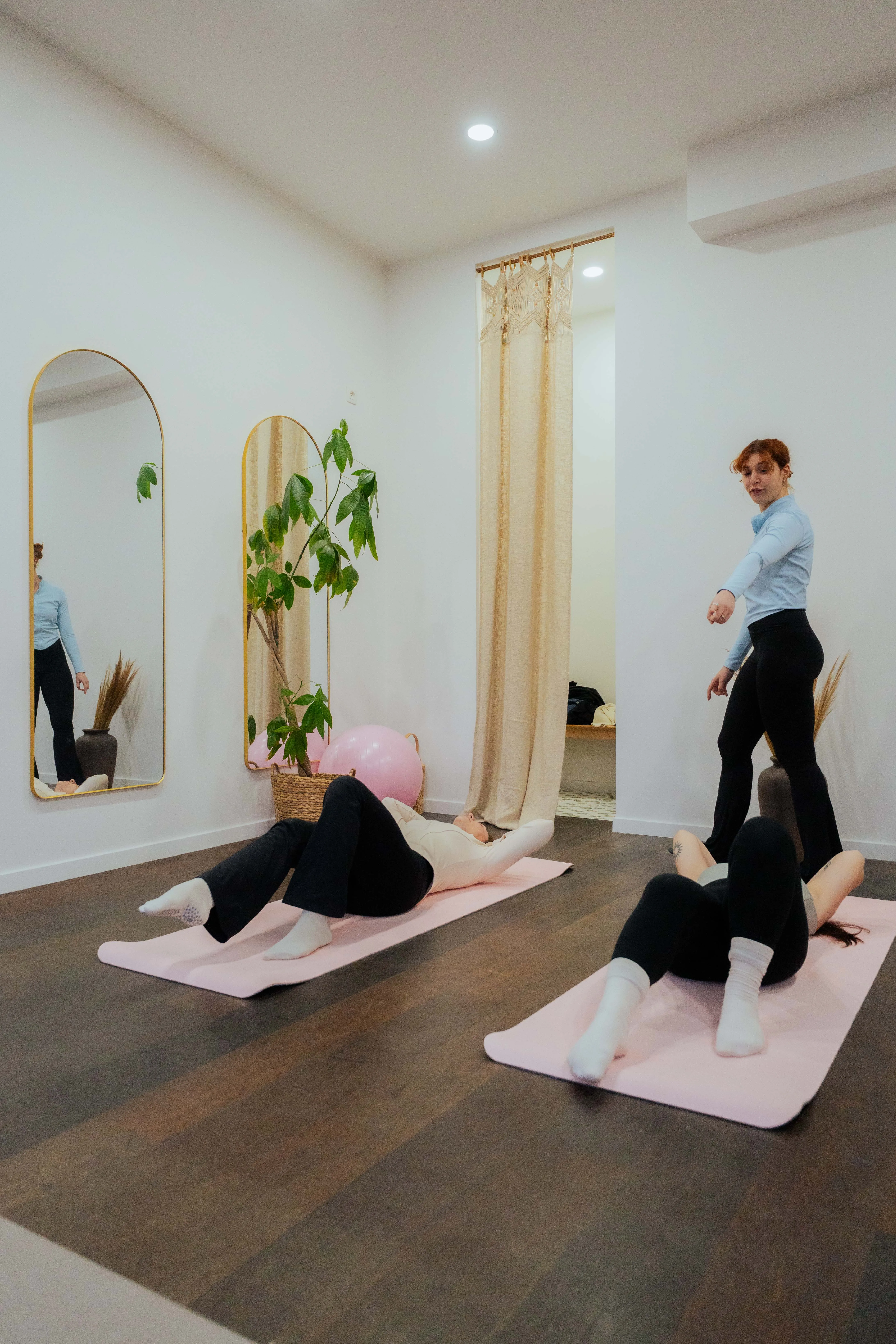
This iconic Pilates exercise combines core stabilization, breath control, and muscular endurance. You hold your legs in a challenging position while pumping your arms rhythmically for one hundred counts, coordinating breath with movement.

  • Why it's powerful: The Hundred forces your deep core muscles to work continuously while your arms and legs create destabilizing forces. This simulates real-world demands on your core – maintaining stability while limbs move independently. The breath coordination also improves cardiovascular conditioning and teaches you to maintain core engagement while breathing fully.

  • The challenge: Without equipment to rest your legs on, your hip flexors and lower abdominals must work significantly harder. This builds genuine strength and endurance that translates to improved performance in virtually every activity.

Roll-Up – Spinal articulation and core control:

The roll-up teaches you to move through your spine one vertebra at a time, rolling from lying flat to sitting tall, then reversing with control. This exercise combines flexibility, core strength, and body control.

  • Why it's powerful: Rolling up against gravity with no assistance requires exceptional abdominal strength and spinal mobility. The exercise teaches you to initiate movement from your core, articulate through your spine segment by segment, and control your body's descent back down. This level of control is extraordinarily functional for daily movements.

  • The reality check: Many people find roll-ups initially impossible – and that's valuable feedback. It reveals exactly where you lack strength or flexibility, giving you a clear goal to work toward. As you progress, the roll-up becomes a beautiful demonstration of your developing strength and control.

Teaser – The ultimate core challenge:

The Teaser is considered one of Pilates' most challenging exercises. You balance on your sit bones with legs and torso forming a V-shape, arms reaching toward your feet. This exercise demands total body integration and extraordinary core strength.

  • Why it's powerful: The Teaser requires simultaneous strength, balance, flexibility, and control. Your entire core – front, back, and sides – must work together to hold this position. There's nowhere to hide, no equipment to help. It's pure body control.

  • Progression path: Few people can perform a full Teaser immediately, and that's perfectly fine. The journey toward this exercise builds incredible functional strength. Modified versions – bending your knees, holding your legs, or performing partial teasers – provide the same training effect while you build capacity.

Plank variations – Full-body integration:

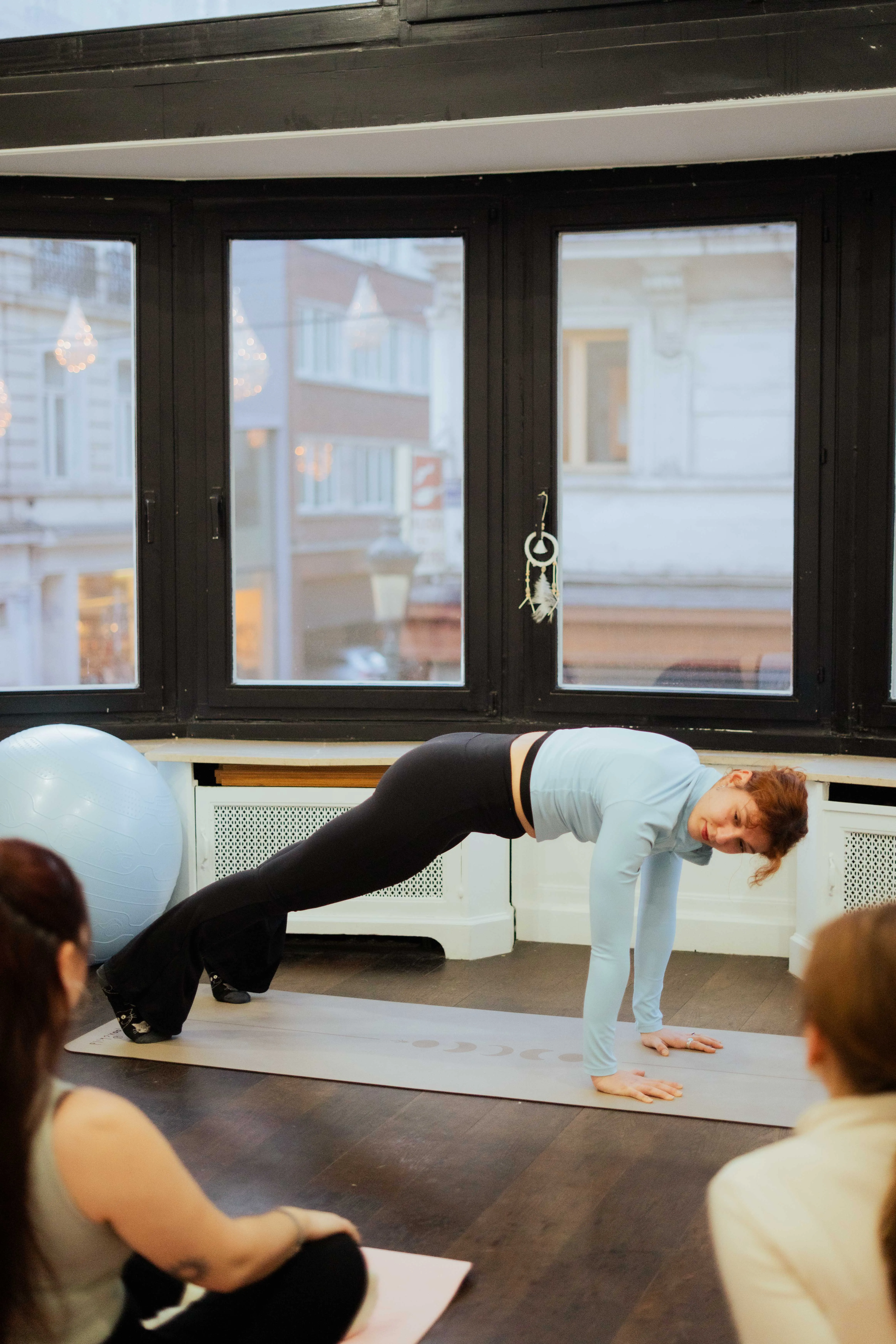
Mat Pilates planks go far beyond simply holding a position. You'll flow from plank to down stretch to up stretch, perform push-ups with Pilates precision, transition to side planks, and more.

  • Why it's powerful: These exercises build full-body strength and stability while teaching you to maintain core engagement during dynamic movements. The transitions between positions challenge your coordination and control, developing functional strength for real-world movements.

  • Pilates difference: Unlike generic planks, Pilates variations emphasize proper shoulder blade placement, breath coordination, and flowing movement. You're not just enduring a static hold – you're actively engaging your entire body with precision.

Single and Double Leg Stretch – Coordination mastery:

These exercises coordinate arm and leg movements while maintaining absolute stability in your torso. As your limbs move through various positions, your core must prevent any rocking, twisting, or shifting.

  • Why it's powerful: This type of exercise directly trains the stability you need for walking, running, and all athletic movements – your limbs move dynamically while your center remains stable. The coordination required also sharpens your mind-body connection and improves overall body control.

Building functional strength without equipment

How mat Pilates creates real-world strength: The strength you build through mat Pilates differs fundamentally from isolated muscle work. It's functional, integrated, and immediately applicable to daily life.

  • Anti-movement strength: Many mat exercises train your body to resist unwanted movement – preventing rotation during single-leg exercises, avoiding spinal flexion during extensions, maintaining pelvic stability when limbs move. This "anti-movement" strength is crucial for injury prevention and athletic performance.

  • Eccentric control: Mat Pilates emphasizes controlled lowering and lengthening of muscles under tension – eccentric contractions. This type of training builds incredible strength and creates the control needed for safe, graceful movement. Think about slowly lowering into a roll-up or controlling your descent in a push-up.

  • Isometric endurance: Holding positions while moving limbs – like maintaining a lifted torso during leg stretches – builds isometric strength and endurance. This teaches your muscles to sustain effort over time, improving your capacity for prolonged physical activity.

  • Multi-planar movement: Unlike machines that typically move in one plane, mat Pilates trains your body through flexion, extension, rotation, and lateral movements. This multi-planar training creates balanced strength and protects against injury during unpredictable movements.

The mind-body connection advantage

Why mat Pilates sharpens mental focus: The mental demands of mat Pilates contribute significantly to its effectiveness and set it apart from many other forms of exercise.

  • Complete concentration required: Without equipment to guide your movement, you must maintain intense focus on your body position, muscle engagement, and movement quality. This concentration becomes a moving meditation that quiets mental chatter and reduces stress.

  • Constant feedback loop: Mat work creates an immediate feedback system. If your core isn't engaged properly, you can't perform the exercise. If your alignment is off, you feel it instantly. This real-time feedback accelerates learning and body awareness.

  • Breath integration: The specific breathing patterns in Pilates do more than oxygenate your muscles – they help regulate your nervous system, reduce stress, and maintain the mind-body connection throughout your practice. This breathwork becomes a tool you can use anytime to manage stress and tension.

  • Mindfulness in motion: Mat Pilates practices mindfulness through movement. You're fully present with each exercise, aware of subtle shifts in position, muscle engagement, and movement quality. This mindfulness extends beyond the mat, improving your awareness and presence in daily life.

Creating an effective mat Pilates practice

Structuring your sessions for maximum benefit: Knowing how to structure your mat practice ensures you get comprehensive benefits while progressing safely and effectively.

  • Balanced session structure: A complete mat Pilates session should include exercises that work your entire body – core work, spinal articulation, hip and leg strengthening, arm and shoulder work, and stretching. This balance ensures no muscle group is neglected and prevents overuse injuries.

  • Progression principles: Start each session with simpler exercises that warm your body and establish your mind-body connection. Progress to more challenging work in the middle of your session when you're fully warmed up and focused. End with stretching and exercises that integrate everything you've worked on.

  • Quality over quantity: A 30-minute session performed with complete focus and perfect form delivers better results than an hour of distracted, sloppy work. Every repetition should be deliberate and controlled.

  • Regular assessment: Periodically return to exercises you found challenging when you started. These "benchmark" exercises show your progress and reveal where you still need to focus your efforts.

Mat Pilates for athletic performance

How bodyweight training enhances sports performance: Elite athletes across all sports increasingly incorporate mat Pilates into their training because it develops qualities that transfer directly to improved performance.

  • Core stability for power transfer: Athletes generate power from their core and transfer it through their limbs. Mat Pilates builds the core stability needed to create and control this power transfer efficiently, improving performance in everything from golf to tennis to running.

  • Injury prevention: The balanced strength development and improved body awareness from mat Pilates significantly reduce injury risk. You learn to move with proper alignment and control, protecting joints and connective tissues from the repetitive stress of training.

  • Recovery and active rest: Mat Pilates serves as excellent active recovery between intense training sessions. The controlled movements promote circulation, reduce muscle tension, and maintain fitness without the impact stress of running or the joint compression of heavy lifting.

  • Mental training: The concentration and mind-body connection developed through mat Pilates improve an athlete's ability to stay present during competition and execute movements with precision under pressure.

Common misconceptions about mat Pilates

Addressing the myths: Several misconceptions prevent people from discovering the power of mat Pilates. Let's address them directly.

  • "It's too easy to be effective": This misconception crumbles the moment you attempt exercises like the Hundred, Teaser, or advanced plank variations. Mat Pilates can be scaled to challenge anyone at any level. The perception of ease usually comes from watching experienced practitioners make difficult exercises look effortless – that's a testament to their skill, not the exercise's difficulty.

  • "You need equipment to build real strength": Research consistently shows that bodyweight training builds significant strength when performed progressively. Mat Pilates creates resistance through leverage, positioning, and gravity – often making exercises harder than their equipment-based counterparts.

  • "It's just stretching": While Pilates does improve flexibility, it's primarily a strength-building practice. The strengthening happens through full ranges of motion, which creates the illusion of "just stretching" to observers. Try holding a Teaser for 30 seconds and tell me it's just stretching.

  • "You need equipment to progress": The infinite variations and progressions available in mat work mean you can continue challenging yourself for years without ever touching equipment. Small adjustments in tempo, range, or limb position create entirely new exercises.

Making mat Pilates work for you

Practical tips for success: Here's how to maximize the benefits of your mat Pilates practice and create lasting results.

  • Invest in quality instruction: While mat Pilates is simple in concept, proper form is crucial for both safety and effectiveness. Working with a qualified instructor – even for just a few sessions – establishes proper technique that you'll carry forward into independent practice.

  • Create a dedicated space: You don't need much – just enough room for your mat and space to extend your arms and legs. Having a dedicated practice space makes it easier to maintain consistency.

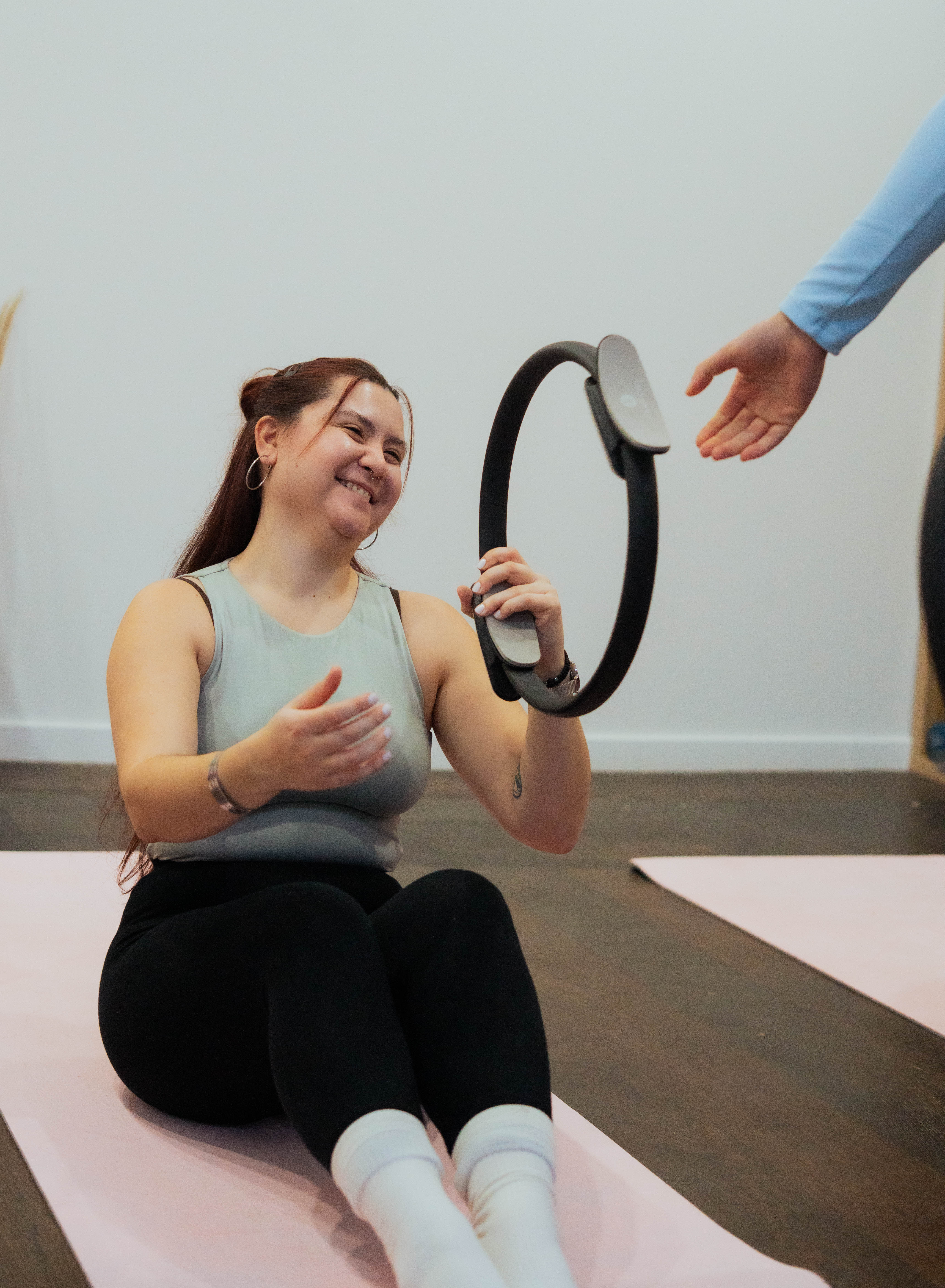
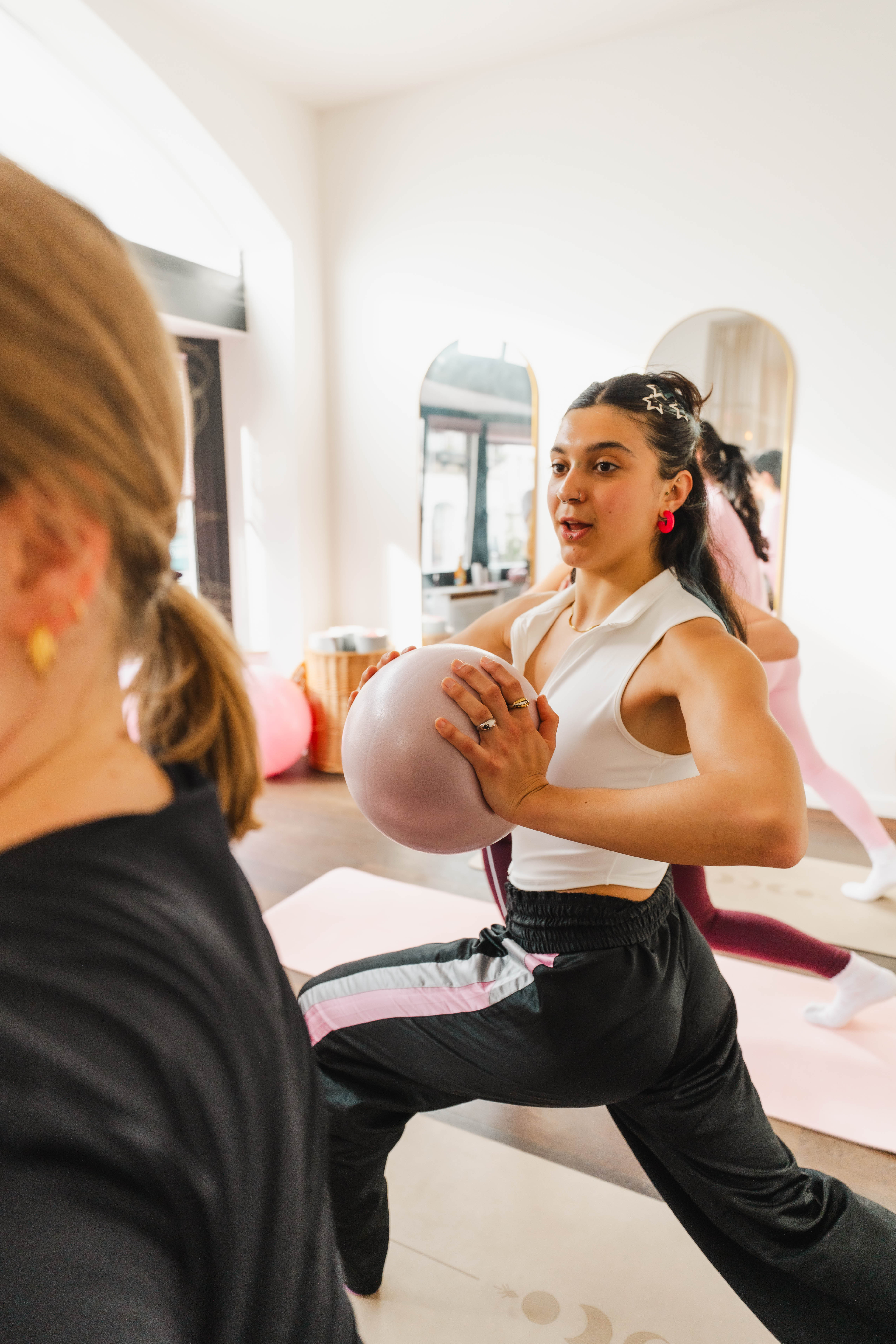
  • Use minimal props wisely: While mat Pilates is primarily bodyweight work, small props like resistance bands, small balls, or blocks can add valuable variety to your practice. These simple, inexpensive tools create new challenges without requiring expensive equipment.

  • Progress intelligently: Honor your body's current capabilities while challenging yourself appropriately. Mastering modified versions of exercises with perfect form serves you better than struggling through advanced variations with poor alignment.

  • Track your progress: Keep notes on which exercises you find challenging, modifications you use, and milestones you achieve. This tracking helps you see progress that might otherwise feel invisible and guides your practice focus.

In summary

Mat Pilates represents the purest expression of Joseph Pilates' original vision – developing complete control of your body through focused, precise movement. Far from being a simplified version of equipment-based Pilates, mat work offers unique benefits that no machine can replicate: the challenge of supporting your entire body weight, the development of deep proprioceptive awareness, and the freedom to practice anywhere, anytime.

The beauty of mat Pilates lies in its elegant simplicity. With nothing but a mat and your own body, you have access to a comprehensive training system that builds functional strength, improves flexibility, enhances body awareness, and sharpens mental focus. The exercises scale infinitely to meet you exactly where you are while providing room for continuous growth and challenge.

In our modern fitness landscape filled with complicated equipment and trendy workout programs, mat Pilates stands as proof that the most effective solutions are often the simplest. Your body is the ultimate piece of exercise equipment – learning to use it masterfully through mat Pilates creates strength, grace, and resilience that enhances every aspect of your physical life.

Whether you're seeking an accessible entry point into fitness, a complement to your current training, or a complete practice that you can maintain for life, mat Pilates delivers. The practice begins with a single session and unfolds into a journey of continuous discovery about what your body can achieve. All you need is a mat, an open mind, and the willingness to embrace the profound challenge of mastering your own movement.
Mat Pilates: Why This Simple Practice Delivers Extraordinary Results

In a fitness world obsessed with high-tech equipment, complicated machines, and the latest workout gadgets, there's something refreshingly pure about mat Pilates. Armed with nothing more than a mat and your own body weight, you can access one of the most comprehensive and effective fitness systems ever created. Yet many people wonder: can something so simple really deliver results comparable to equipment-based workouts?

The answer is a resounding yes – and in many ways, mat Pilates offers benefits that equipment-based training simply cannot match. When Joseph Pilates developed his method in the early 20th century, the mat exercises formed the core of his system. These exercises weren't simplified versions of machine work – they were the foundation, designed to develop total body control, functional strength, and the mind-body connection that makes Pilates so transformative.

What makes mat Pilates particularly remarkable is its elegant simplicity. Without equipment to assist or support you, your body must do all the work. This creates a level of challenge and body awareness that builds genuine functional strength – the kind of strength that translates directly into improved performance in sports, daily activities, and quality of life. You're not just moving a carriage or pulling springs; you're mastering the art of controlling your own body in space.

In this comprehensive guide, we'll explore why mat Pilates stands as one of the most effective forms of exercise available, how it builds strength and flexibility that equipment often can't replicate, and why this accessible practice might be exactly what your body needs. Whether you're new to Pilates or experienced with other forms of training, understanding the unique power of mat work will deepen your appreciation for this deceptively simple yet profoundly effective practice.

The philosophy behind mat Pilates

Mastering your own body weight: At the heart of mat Pilates lies a fundamental principle: true strength comes from the ability to control your own body through space with precision and grace. This philosophy shapes everything about the practice.

  • Body as the ultimate equipment: Your body is the most sophisticated piece of exercise equipment ever created. It has infinite variations in positioning, countless muscle activation patterns, and the ability to provide exactly the right resistance for your current strength level. Mat Pilates teaches you to use this equipment masterfully.

  • Functional movement patterns: Unlike machines that isolate specific muscles or movement paths, mat Pilates trains your body through natural, multi-planar movements. You learn to coordinate multiple muscle groups simultaneously – exactly how your body needs to function in real life.

  • Self-reliance and empowerment: When you practice mat Pilates, success depends entirely on your own effort, focus, and body awareness. There's no machine to assist you, no springs to help lift your legs. This self-reliance builds confidence and a deep sense of physical empowerment.

  • Accessibility and freedom: Perhaps most importantly, mat Pilates gives you complete freedom. Once you learn the exercises, you can practice anywhere, anytime – at home, while traveling, in a park, or in your office during lunch break. This accessibility removes barriers that prevent consistent practice.

The unique benefits of mat Pilates

Why bodyweight training builds superior functional strength: Mat Pilates offers specific advantages that equipment-based training cannot replicate. Understanding these benefits helps you appreciate the deceptive power of this simple practice.

  • True core challenge: Without equipment to provide support or assistance, your core must work constantly to stabilize your body during every exercise. This creates a level of core engagement that develops deep, functional strength rather than superficial muscle development. Your body learns to create its own stability rather than relying on external support.

  • Proprioceptive development: Proprioception – your body's awareness of its position in space – develops more profoundly with mat work because you receive no tactile feedback from equipment. You must rely entirely on internal awareness to know if you're aligned properly, engaging the right muscles, and moving with control.

  • Scalable difficulty: The beauty of mat Pilates lies in its infinite scalability. The same exercise that challenges a beginner can be progressed through subtle adjustments to challenge even the most advanced practitioner. Small changes in tempo, range of motion, or limb position create entirely new levels of difficulty.

  • Movement integration: Mat exercises typically involve coordinating multiple body parts simultaneously – reaching your arms while extending your legs, rotating your torso while maintaining pelvic stability. This integration trains your nervous system to coordinate complex movement patterns, improving overall athleticism.

  • Balanced development: Mat Pilates systematically works your entire body in multiple planes of motion. You'll strengthen in flexion, extension, rotation, and lateral movements. This comprehensive approach prevents the muscular imbalances that often develop from repetitive sports or exercise routines.

Essential mat Pilates exercises and their power

The core repertoire that transforms bodies: These fundamental mat exercises demonstrate why bodyweight Pilates is so effective. Each exercise serves multiple purposes, working numerous muscle groups while teaching control and coordination.

The Hundred – Building endurance and core power:

This iconic Pilates exercise combines core stabilization, breath control, and muscular endurance. You hold your legs in a challenging position while pumping your arms rhythmically for one hundred counts, coordinating breath with movement.

  • Why it's powerful: The Hundred forces your deep core muscles to work continuously while your arms and legs create destabilizing forces. This simulates real-world demands on your core – maintaining stability while limbs move independently. The breath coordination also improves cardiovascular conditioning and teaches you to maintain core engagement while breathing fully.

  • The challenge: Without equipment to rest your legs on, your hip flexors and lower abdominals must work significantly harder. This builds genuine strength and endurance that translates to improved performance in virtually every activity.

Roll-Up – Spinal articulation and core control:

The roll-up teaches you to move through your spine one vertebra at a time, rolling from lying flat to sitting tall, then reversing with control. This exercise combines flexibility, core strength, and body control.

  • Why it's powerful: Rolling up against gravity with no assistance requires exceptional abdominal strength and spinal mobility. The exercise teaches you to initiate movement from your core, articulate through your spine segment by segment, and control your body's descent back down. This level of control is extraordinarily functional for daily movements.

  • The reality check: Many people find roll-ups initially impossible – and that's valuable feedback. It reveals exactly where you lack strength or flexibility, giving you a clear goal to work toward. As you progress, the roll-up becomes a beautiful demonstration of your developing strength and control.

Teaser – The ultimate core challenge:

The Teaser is considered one of Pilates' most challenging exercises. You balance on your sit bones with legs and torso forming a V-shape, arms reaching toward your feet. This exercise demands total body integration and extraordinary core strength.

  • Why it's powerful: The Teaser requires simultaneous strength, balance, flexibility, and control. Your entire core – front, back, and sides – must work together to hold this position. There's nowhere to hide, no equipment to help. It's pure body control.

  • Progression path: Few people can perform a full Teaser immediately, and that's perfectly fine. The journey toward this exercise builds incredible functional strength. Modified versions – bending your knees, holding your legs, or performing partial teasers – provide the same training effect while you build capacity.

Plank variations – Full-body integration:

Mat Pilates planks go far beyond simply holding a position. You'll flow from plank to down stretch to up stretch, perform push-ups with Pilates precision, transition to side planks, and more.

  • Why it's powerful: These exercises build full-body strength and stability while teaching you to maintain core engagement during dynamic movements. The transitions between positions challenge your coordination and control, developing functional strength for real-world movements.

  • Pilates difference: Unlike generic planks, Pilates variations emphasize proper shoulder blade placement, breath coordination, and flowing movement. You're not just enduring a static hold – you're actively engaging your entire body with precision.

Single and Double Leg Stretch – Coordination mastery:

These exercises coordinate arm and leg movements while maintaining absolute stability in your torso. As your limbs move through various positions, your core must prevent any rocking, twisting, or shifting.

  • Why it's powerful: This type of exercise directly trains the stability you need for walking, running, and all athletic movements – your limbs move dynamically while your center remains stable. The coordination required also sharpens your mind-body connection and improves overall body control.

Building functional strength without equipment

How mat Pilates creates real-world strength: The strength you build through mat Pilates differs fundamentally from isolated muscle work. It's functional, integrated, and immediately applicable to daily life.

  • Anti-movement strength: Many mat exercises train your body to resist unwanted movement – preventing rotation during single-leg exercises, avoiding spinal flexion during extensions, maintaining pelvic stability when limbs move. This "anti-movement" strength is crucial for injury prevention and athletic performance.

  • Eccentric control: Mat Pilates emphasizes controlled lowering and lengthening of muscles under tension – eccentric contractions. This type of training builds incredible strength and creates the control needed for safe, graceful movement. Think about slowly lowering into a roll-up or controlling your descent in a push-up.

  • Isometric endurance: Holding positions while moving limbs – like maintaining a lifted torso during leg stretches – builds isometric strength and endurance. This teaches your muscles to sustain effort over time, improving your capacity for prolonged physical activity.

  • Multi-planar movement: Unlike machines that typically move in one plane, mat Pilates trains your body through flexion, extension, rotation, and lateral movements. This multi-planar training creates balanced strength and protects against injury during unpredictable movements.

The mind-body connection advantage

Why mat Pilates sharpens mental focus: The mental demands of mat Pilates contribute significantly to its effectiveness and set it apart from many other forms of exercise.

  • Complete concentration required: Without equipment to guide your movement, you must maintain intense focus on your body position, muscle engagement, and movement quality. This concentration becomes a moving meditation that quiets mental chatter and reduces stress.

  • Constant feedback loop: Mat work creates an immediate feedback system. If your core isn't engaged properly, you can't perform the exercise. If your alignment is off, you feel it instantly. This real-time feedback accelerates learning and body awareness.

  • Breath integration: The specific breathing patterns in Pilates do more than oxygenate your muscles – they help regulate your nervous system, reduce stress, and maintain the mind-body connection throughout your practice. This breathwork becomes a tool you can use anytime to manage stress and tension.

  • Mindfulness in motion: Mat Pilates practices mindfulness through movement. You're fully present with each exercise, aware of subtle shifts in position, muscle engagement, and movement quality. This mindfulness extends beyond the mat, improving your awareness and presence in daily life.

Creating an effective mat Pilates practice

Structuring your sessions for maximum benefit: Knowing how to structure your mat practice ensures you get comprehensive benefits while progressing safely and effectively.

  • Balanced session structure: A complete mat Pilates session should include exercises that work your entire body – core work, spinal articulation, hip and leg strengthening, arm and shoulder work, and stretching. This balance ensures no muscle group is neglected and prevents overuse injuries.

  • Progression principles: Start each session with simpler exercises that warm your body and establish your mind-body connection. Progress to more challenging work in the middle of your session when you're fully warmed up and focused. End with stretching and exercises that integrate everything you've worked on.

  • Quality over quantity: A 30-minute session performed with complete focus and perfect form delivers better results than an hour of distracted, sloppy work. Every repetition should be deliberate and controlled.

  • Regular assessment: Periodically return to exercises you found challenging when you started. These "benchmark" exercises show your progress and reveal where you still need to focus your efforts.

Mat Pilates for athletic performance

How bodyweight training enhances sports performance: Elite athletes across all sports increasingly incorporate mat Pilates into their training because it develops qualities that transfer directly to improved performance.

  • Core stability for power transfer: Athletes generate power from their core and transfer it through their limbs. Mat Pilates builds the core stability needed to create and control this power transfer efficiently, improving performance in everything from golf to tennis to running.

  • Injury prevention: The balanced strength development and improved body awareness from mat Pilates significantly reduce injury risk. You learn to move with proper alignment and control, protecting joints and connective tissues from the repetitive stress of training.

  • Recovery and active rest: Mat Pilates serves as excellent active recovery between intense training sessions. The controlled movements promote circulation, reduce muscle tension, and maintain fitness without the impact stress of running or the joint compression of heavy lifting.

  • Mental training: The concentration and mind-body connection developed through mat Pilates improve an athlete's ability to stay present during competition and execute movements with precision under pressure.

Common misconceptions about mat Pilates

Addressing the myths: Several misconceptions prevent people from discovering the power of mat Pilates. Let's address them directly.

  • "It's too easy to be effective": This misconception crumbles the moment you attempt exercises like the Hundred, Teaser, or advanced plank variations. Mat Pilates can be scaled to challenge anyone at any level. The perception of ease usually comes from watching experienced practitioners make difficult exercises look effortless – that's a testament to their skill, not the exercise's difficulty.

  • "You need equipment to build real strength": Research consistently shows that bodyweight training builds significant strength when performed progressively. Mat Pilates creates resistance through leverage, positioning, and gravity – often making exercises harder than their equipment-based counterparts.

  • "It's just stretching": While Pilates does improve flexibility, it's primarily a strength-building practice. The strengthening happens through full ranges of motion, which creates the illusion of "just stretching" to observers. Try holding a Teaser for 30 seconds and tell me it's just stretching.

  • "You need equipment to progress": The infinite variations and progressions available in mat work mean you can continue challenging yourself for years without ever touching equipment. Small adjustments in tempo, range, or limb position create entirely new exercises.

Making mat Pilates work for you

Practical tips for success: Here's how to maximize the benefits of your mat Pilates practice and create lasting results.

  • Invest in quality instruction: While mat Pilates is simple in concept, proper form is crucial for both safety and effectiveness. Working with a qualified instructor – even for just a few sessions – establishes proper technique that you'll carry forward into independent practice.

  • Create a dedicated space: You don't need much – just enough room for your mat and space to extend your arms and legs. Having a dedicated practice space makes it easier to maintain consistency.

  • Use minimal props wisely: While mat Pilates is primarily bodyweight work, small props like resistance bands, small balls, or blocks can add valuable variety to your practice. These simple, inexpensive tools create new challenges without requiring expensive equipment.

  • Progress intelligently: Honor your body's current capabilities while challenging yourself appropriately. Mastering modified versions of exercises with perfect form serves you better than struggling through advanced variations with poor alignment.

  • Track your progress: Keep notes on which exercises you find challenging, modifications you use, and milestones you achieve. This tracking helps you see progress that might otherwise feel invisible and guides your practice focus.

In summary

Mat Pilates represents the purest expression of Joseph Pilates' original vision – developing complete control of your body through focused, precise movement. Far from being a simplified version of equipment-based Pilates, mat work offers unique benefits that no machine can replicate: the challenge of supporting your entire body weight, the development of deep proprioceptive awareness, and the freedom to practice anywhere, anytime.

The beauty of mat Pilates lies in its elegant simplicity. With nothing but a mat and your own body, you have access to a comprehensive training system that builds functional strength, improves flexibility, enhances body awareness, and sharpens mental focus. The exercises scale infinitely to meet you exactly where you are while providing room for continuous growth and challenge.

In our modern fitness landscape filled with complicated equipment and trendy workout programs, mat Pilates stands as proof that the most effective solutions are often the simplest. Your body is the ultimate piece of exercise equipment – learning to use it masterfully through mat Pilates creates strength, grace, and resilience that enhances every aspect of your physical life.

Whether you're seeking an accessible entry point into fitness, a complement to your current training, or a complete practice that you can maintain for life, mat Pilates delivers. The practice begins with a single session and unfolds into a journey of continuous discovery about what your body can achieve. All you need is a mat, an open mind, and the willingness to embrace the profound challenge of mastering your own movement.
Lines
Yoga
Yoga
Stretching
Yoga

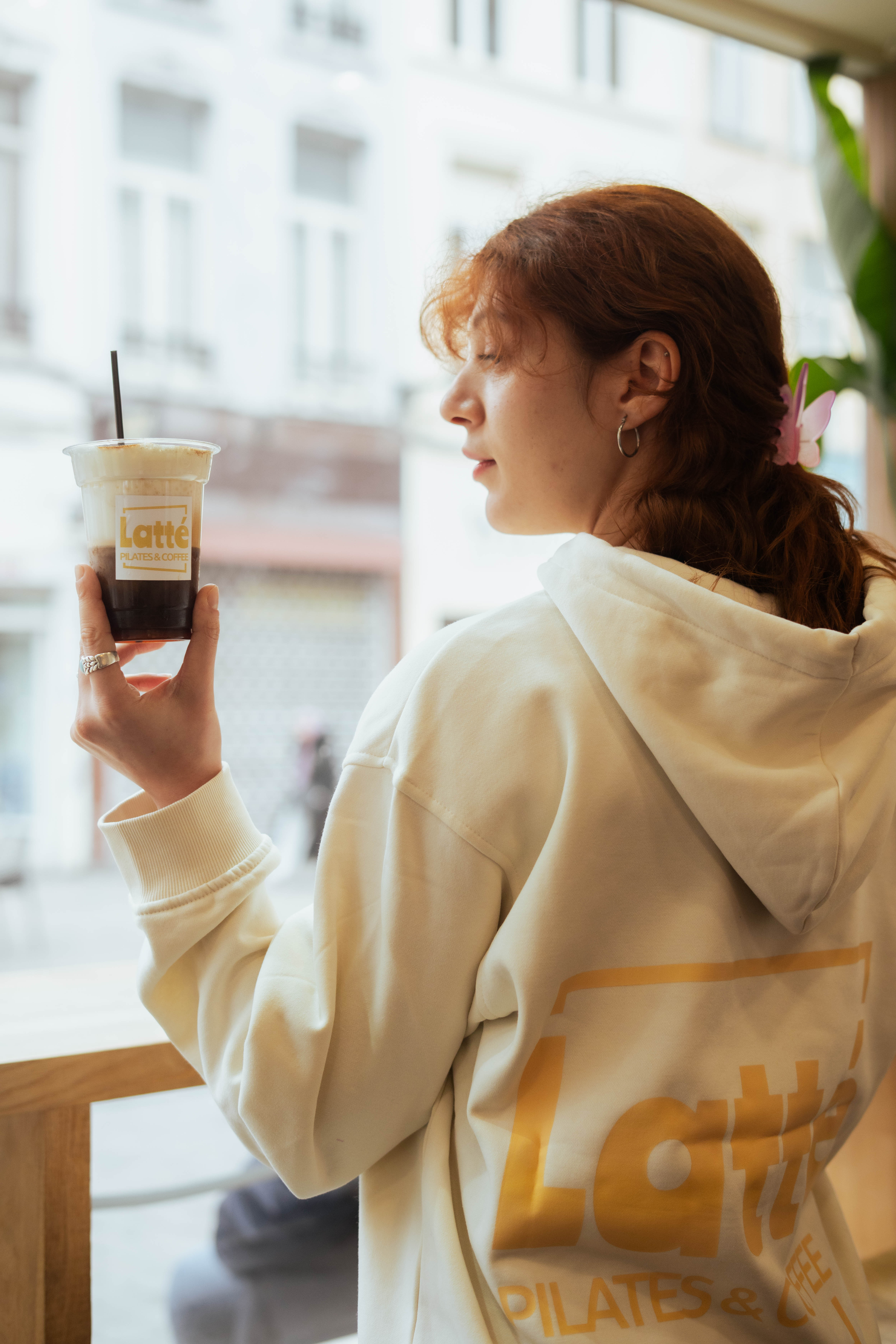
Join 200+ women who've discovered that the best workout ends with the perfect latte.

Lines
Yoga
Yoga
Stretching
Yoga

Join 200+ women who've discovered that the best workout ends with the perfect latte.